Trust Your Senses, Not Your Timer: The Japanese Chef's Guide to Knowing When Food Is Ready
There's a moment in every Okubo kitchen session where someone reaches for their phone to set a timer, and one of the cooks quietly waves them off. Not because timing doesn't matter — it absolutely does — but because the food itself is already telling you everything you need to know. You just have to learn how to listen.
This isn't mysticism. It's a deeply practical skill that Japanese culinary tradition has refined over centuries, and it's one that American home cooks can absolutely develop. The difference between a cook who watches the clock and a cook who watches the pan is the difference between following a recipe and actually understanding food.
Why Timers Create a False Sense of Security
Here's the thing about timers: they work great in a controlled environment where every variable is identical every single time. Your stove isn't that environment. Neither is mine. The BTU output of a gas burner varies. Cast iron holds heat differently than stainless steel. A piece of salmon that came straight from the fridge cooks slower than one that sat on the counter for fifteen minutes. A timer can't account for any of that — but your senses can.
At Okubo, the philosophy is that a timer is a training wheel, not a destination. It's fine to use one when you're first learning a dish. But the goal is always to eventually cook without it, because that's when you're truly cooking and not just executing a sequence of steps.
The Sound of Done: Listening to Your Pan
Sound is probably the most underrated sense in the American kitchen. We tend to think of cooking as visual — we watch for browning, for bubbling, for steam. But Japanese cooks often close their eyes and listen first.
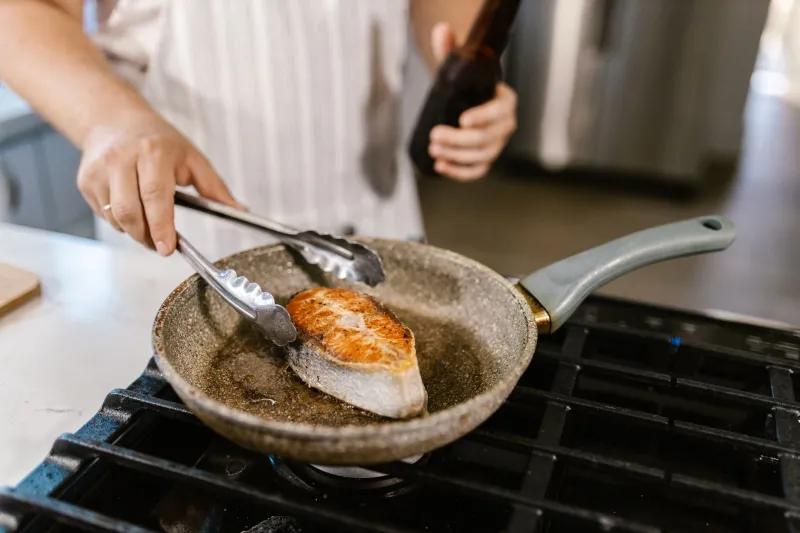
When you add protein to a hot pan, the sizzle tells you immediately whether the temperature is right. A loud, aggressive crack means the pan is too hot. A soft, wet hiss means it's too cool and the food will steam instead of sear. The sound you're listening for is a steady, confident sizzle — consistent and clear, like rain on a tin roof.
As food cooks, that sound evolves. Tempura batter starts with a furious, chaotic bubble and gradually settles into a quieter, more rhythmic sound as moisture escapes and the coating sets. When the bubbling slows significantly and takes on a lower pitch, the tempura is close to done. The oil is no longer fighting the water in the batter — it's won.
For rice, listen for the shift from a rolling simmer to a soft, almost papery crackle at the bottom of the pot. That sound means the water is nearly absorbed and it's time to cut the heat and let the steam finish the job. Miss that moment and you'll have scorched rice. Catch it, and you'll have that prized crispy bottom layer — okoge — that Japanese cooks actually treasure.
Reading Color Like a Map
Color changes in food happen on a spectrum, and learning to read that spectrum is one of the most transferable skills you can develop. Japanese chefs talk about this in terms of stages rather than endpoints — they're not looking for done, they're tracking a progression.
Take the surface of a piece of chicken thigh in a pan. It starts pale pink, then shifts to an opaque white at the edges. That white creeps upward as heat penetrates the meat. When the white reaches about two-thirds of the way up the side of the thigh, experienced cooks at Okubo flip it. Not before, not after. The remaining cooking happens on the second side, and because the interior is already partially set, it finishes evenly without overcooking the exterior.
With vegetables, color is equally telling. Blanched greens — spinach, snap peas, edamame — hit a peak of vivid, almost electric green before they start to dull. That peak lasts maybe thirty seconds. Pull them at that moment and they're perfect: bright, tender, and still with a little life in them. Wait until they look done to your eyes and you've already gone too far.
Miso-glazed dishes develop a deep amber lacquer as the sugars in the miso caramelize. The color should be rich and slightly uneven — darker at the edges, lighter in the center. Uniform browning often means the heat was too low and the glaze dried out rather than caramelized. Trust the variation.
The Feel Test: Resistance as Information
This is where home cooks often hesitate, because touching your food while it's cooking feels somehow wrong. It isn't. It's one of the most direct ways to get information.
Pressing a piece of fish gently with your fingertip tells you an enormous amount. Raw fish feels like pressing the flesh between your thumb and forefinger when your hand is completely relaxed — soft and yielding with no resistance. Perfectly cooked fish flakes just slightly under pressure and springs back a little. Overcooked fish feels firm and dense, almost rubbery.
The same logic applies to noodles. Japanese cooks test soba and udon by touch as much as by taste — properly cooked noodles have a specific give that you can feel when you press a strand between your fingers. There's still a slight core of resistance, what Italians call al dente and Japanese cooks simply call right.
For root vegetables like daikon or kabocha squash simmered in dashi, a bamboo skewer or chopstick inserted into the thickest part should slide in with just a hint of resistance — not like pushing through butter, but not like pushing through clay either. Somewhere in between is where you want to be.
Building the Habit
Developing sensory confidence takes repetition, and the best way to build it is to cook the same dish multiple times with your full attention. Pick something simple — a pan-seared piece of fish, a pot of rice, a batch of sautéed vegetables. Cook it without a timer. Pay attention to every sound, every color shift, every smell. Take notes if that helps.
You'll get it wrong sometimes. That's not failure — that's data. A slightly overcooked piece of salmon is a lesson, not a disaster. Every time you miss the mark, you calibrate your internal sense of what to look and listen for next time.
The cooks at Okubo didn't develop this skill overnight. It came from thousands of repetitions, from watching closely, from asking questions, and from caring enough about the food to stay present while it cooked. That presence — that willingness to actually pay attention — is the real technique. The rest is just practice.
Put the timer away. Your food is already talking. Start listening.