Cracked, Crooked, and Completely Beautiful: How Wabi-Sabi Changes the Way You Cook
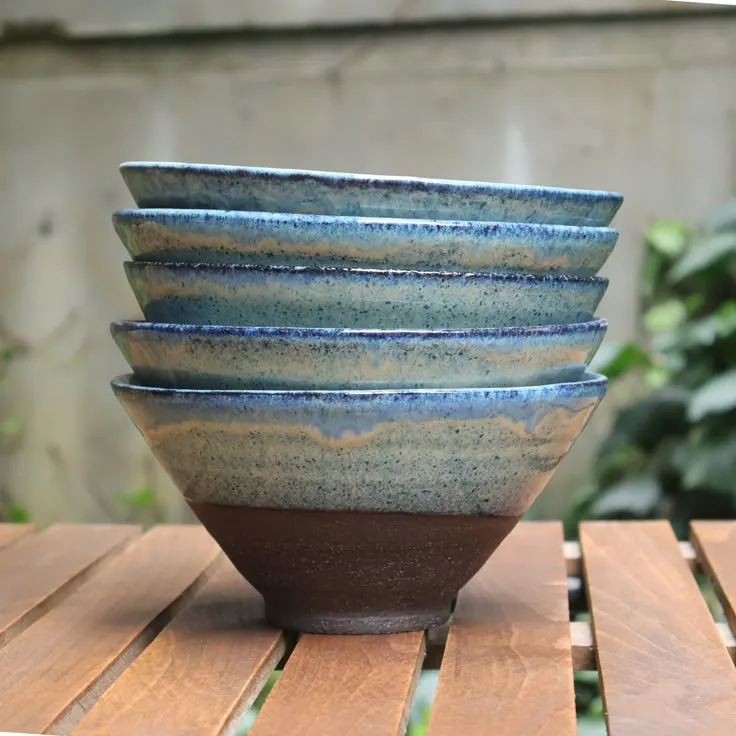
Photo: rustic Japanese ceramic bowl food plating imperfect handmade pottery, via i.pinimg.com
Somewhere along the way, American home cooks got the idea that perfection was the goal. Uniform slices. Symmetrical plating. Garnishes placed with tweezers. Scroll through any food account on Instagram and you'll see it — a kind of relentless, glossy precision that makes cooking feel more like graphic design than, well, cooking.
At KB Kitchen Okubo, we've always believed the opposite. The philosophy running through our kitchen — and through centuries of Japanese culinary tradition — is rooted in something called wabi-sabi. And once you understand it, you might never stress over a lopsided dumpling again.
What Wabi-Sabi Actually Means
Wabi-sabi is one of those Japanese concepts that resists a clean English translation, which is maybe fitting given what it stands for. At its core, it's an appreciation for things that are impermanent, imperfect, and incomplete. It finds beauty in the rough edge, the faded glaze, the vegetable that grew a little sideways.
In Japanese aesthetics, a hand-thrown ceramic bowl with a slightly uneven rim isn't defective — it's alive. It carries the mark of the hands that made it. That same logic applies directly to food. A piece of fish that's seared with a little more char on one end, a mound of rice that settles into its own natural shape, a broth that's a shade darker than yesterday's batch — these aren't failures. They're evidence that a real person made something real.
Our chefs at Okubo talk about this constantly. Not in a formal, lecture-hall kind of way, but in small moments during prep — the way a senior cook might pause over a plate and say, leave it, when a younger cook reaches to adjust something that doesn't need adjusting.
The Problem with Chasing Precision
Here's the thing about kitchen perfectionism: it's exhausting, and it often makes the food worse.
When you're focused on getting every slice exactly the same thickness, you stop paying attention to how the ingredient feels under your knife. When you're fussing over the geometry of your plating, you lose track of whether the dish is actually still warm. And when you decide the whole meal is ruined because the sauce broke slightly or the cake didn't rise perfectly even, you've let an abstract standard override the real thing sitting in front of you — which is probably still delicious.
Japanese culinary tradition has a different relationship with control. Rather than imposing order on ingredients, the idea is to work with what they naturally offer. A daikon that grew a little knobby gets cut in a way that honors its actual shape. A mushroom cap that's slightly torn gets placed so the tear faces down, or — in the wabi-sabi spirit — it gets placed so the tear faces up, because that's just what it is.
How This Shows Up in Our Kitchen
At KB Kitchen Okubo, you'll notice a few things if you pay attention to how dishes arrive at the table. Garnishes are rarely placed dead-center. Sauces are spooned in a way that allows them to find their own edge. Proteins aren't always cut into identical portions — the natural thickness of a piece of fish or the grain of a cut of meat guides the knife more than any ruler would.
This isn't laziness or cutting corners. It takes real skill to place something imperfectly in a way that still looks intentional. There's a Japanese term, ma, which refers to negative space — the deliberate emptiness around an object that gives it room to breathe. Wabi-sabi and ma work together in plating. A single pickled vegetable placed slightly off to one side of a bowl creates tension and movement. That same vegetable placed dead-center looks like a diagram.
Our chefs train their eye over years of practice. But the mindset — the permission to let things be a little irregular — is something any home cook can adopt starting tonight.
Practical Ways to Bring Wabi-Sabi Into Your Home Kitchen
You don't need to overhaul your cooking style. You just need to loosen your grip a little.
Stop correcting every cut. If you're slicing scallions and some pieces come out slightly thicker than others, let it go. Those variations actually create more textural interest in the finished dish.
Let your plating breathe. Instead of piling everything in the center of the plate, try placing components with some intentional spacing. Leave parts of the plate empty. Resist the urge to fill every gap.
Use imperfect vessels. If you have any hand-thrown pottery, mismatched bowls, or ceramics with visible texture, use them. The irregularity of the vessel makes the food inside look more considered, not less.
Reframe your mistakes. A sauce that's slightly thicker than planned isn't wrong — it's just a different sauce. A vegetable that caramelized more than expected isn't burnt — it's got depth. Start asking what does this want to be instead of why didn't this go the way I planned.
Taste over appearance. This is the most important one. Wabi-sabi ultimately reminds us that the experience of food — its smell, its warmth, the way it sits on your tongue — matters more than how it photographs. Cook for the people at your table, not for an imaginary judge.
The Confidence That Comes From Letting Go
There's a real psychological shift that happens when you stop chasing perfection in the kitchen. Cooking becomes less stressful. You start noticing things you were too anxious to notice before — the way onions smell different at each stage of caramelization, the sound a good sear makes versus a mediocre one, the way a well-made broth moves in the pot.
At KB Kitchen Okubo, we've watched this shift happen in our own cooks. The ones who embrace imperfection tend to become better cooks faster, not because they're less careful, but because they're more present. They're not managing a performance. They're actually cooking.
Wabi-sabi won't make your food look worse. If anything, it'll make it look more honest — and in a world full of artificially perfect food content, honest is exactly what people are hungry for.