Why Holding Back Is the Boldest Move a Cook Can Make
Most of us were taught that more is more. More seasoning. More garnish. More steps. More heat. American cooking culture — shaped by abundance, by the idea that generosity lives in excess — tends to reward the cook who piles it on. A great dish, by that logic, is a full dish.
But walk into any serious Japanese kitchen, including ours here at KB Kitchen Okubo, and you'll feel something different almost immediately. There's a stillness to the process. Things are done and then — deliberately, intentionally — not done. Ingredients are added, and then the cook steps back. The flame is turned down before it needs to be. The plate is set without a final flourish.
That's not restraint born from laziness. That's ma.
What Is Ma, Exactly?
Ma (間) is one of those Japanese concepts that resists clean translation, which is maybe part of why it's so powerful. Literally, it refers to negative space — the pause between notes in music, the gap between objects in a room, the breath between words in a conversation. It's the idea that what isn't there shapes the experience of what is.
In Japanese art, architecture, and design, ma is foundational. A room with one carefully chosen object communicates more than a room stuffed with furniture. A haiku lands harder than a paragraph because the white space around the words gives each one room to resonate.
In cooking, ma works the same way. When every flavor is competing for attention, nothing wins. When you deliberately leave room — in the seasoning, in the technique, in the plating — the ingredients that are present get to speak at full volume.
At Okubo, this isn't abstract philosophy. It's a daily kitchen practice.
The Three Places Our Chefs Apply It
1. Seasoning — Stop Before You Think You Should
The single most common mistake home cooks make isn't under-seasoning. It's over-correcting. You taste, you add, you taste again, you add again — and before long, the dish has become about salt and acid rather than about the ingredient you started with.
Our chefs season in stages, yes (if you've read our piece on layering flavor, you know this), but the key habit is knowing when the last stage is the last stage. There's a point in every dish where the ingredient's natural flavor is doing the work, and the cook's job is simply to get out of the way. That point usually arrives earlier than you expect.
A piece of fresh sablefish — buttery, ocean-forward, almost sweet on its own — needs almost nothing. A light brush of shio koji, a few minutes of rest, and the fish itself becomes the seasoning. Adding more would be noise.
2. Heat — The Courage to Turn It Down
American cooking often defaults to high heat. We like a sear. We like caramelization. We like the drama of a hot pan and the sound it makes. And those things are genuinely useful — but they're not always the answer.
Japanese techniques frequently work at lower temperatures for longer periods, or use brief, controlled bursts of heat followed by deliberate rest. Think about the way a proper tamago (Japanese rolled egg) is made: low heat, constant attention, tiny adjustments. You're not forcing the egg to cook. You're coaxing it.
The ma here is in the space between heat applications — the moments where you pull back and let residual warmth do the finishing work. Overcooking a piece of fish or a bowl of miso is almost always the result of not trusting that pause. The food needs a moment. Give it one.
3. Garnish — When the Plate Is Done Before You Think It Is
This one might be the hardest for American home cooks to embrace, because we're wired to finish a dish with something. A handful of herbs. A drizzle of oil. A sprinkle of sesame. And sometimes, yes — that final touch is exactly right.
But our chefs ask a different question before adding anything to a finished plate: Does this need this, or do I just want to add it? Those are not the same thing.
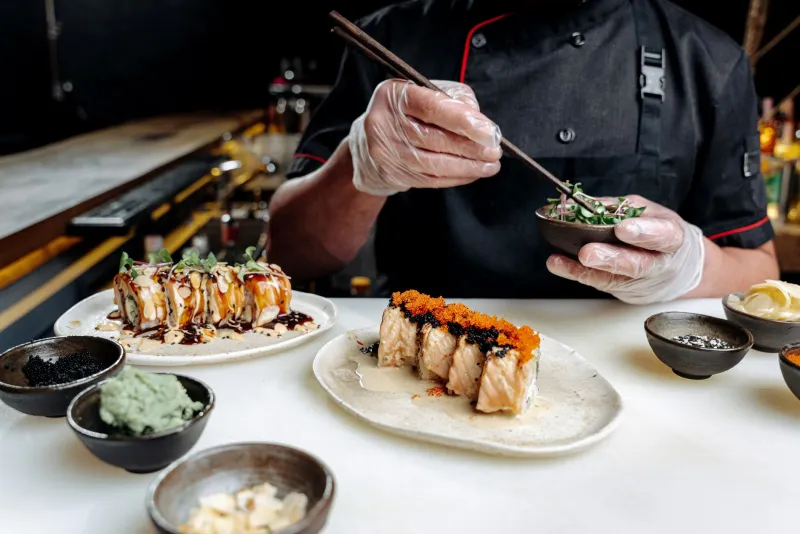
Japanese plating philosophy draws on ma constantly. A single shiso leaf placed with intention says more than a scattered pile of microgreens. A few drops of yuzu oil in one corner of the bowl creates a destination for the eye — and the nose — in a way that a full drizzle across the surface never could. The empty space on the plate isn't emptiness. It's breathing room for the food that's already there.
Why This Resonates Right Now
Here's the thing: American home cooks are increasingly exhausted by complicated recipes. The multi-component weeknight dinners. The seventeen-ingredient sauces. The pressure to make every meal a full production. And what people are finding — slowly, gratefully — is that simpler food, made with better technique and more intentional restraint, often tastes more satisfying.
That's not a trend. That's ma, working exactly the way it's supposed to.
When you stop adding and start editing, you become a more confident cook. You start to trust your ingredients. You stop masking and start revealing. And the food you make starts to taste like it came from somewhere — like it has a point of view.
A Simple Practice to Try This Week
You don't need to overhaul your entire approach to cooking. Start with one meal and apply a single rule: after you think the dish is done, wait two minutes before adding anything else.
Taste it. Sit with it. Ask yourself whether what's in the bowl is actually asking for more, or whether you're just filling silence out of habit.
More often than not, you'll find the dish is already finished. You just needed to recognize the moment.
That recognition — that willingness to stop — is the whole practice. It's what our chefs at KB Kitchen Okubo work on every day, not because it's easy, but because it's the difference between food that impresses and food that actually moves you.
The most powerful thing you can put on a plate is sometimes the thing you decided to leave off.