Before You Break the Rules, You Have to Know Them: What Kata Teaches Us About Creative Cooking
Somewhere along the way, American food culture decided that the best cooking comes from instinct. From feeling your way through a dish, adding what seems right, substituting freely, and generally treating recipes as loose suggestions rather than structured learning tools. There's a romanticism to that idea — the fearless home cook who just knows — and it's not entirely wrong.
But it's missing something important. And the Japanese concept of kata is the thing it's missing.
What Kata Actually Means
Most Americans who know the word kata know it from martial arts — it's the precisely choreographed sequence of movements that martial arts students practice thousands of times before they ever spar with an opponent. Every angle of the wrist, every shift of weight, every breath is specified and repeated until the body executes it without conscious instruction.
That might sound like the opposite of creativity. It's actually the foundation of it.
The logic of kata is this: if you have to think about how to throw a punch, you can't also think about when to throw it, where to aim, or how to read your opponent. The mechanics have to be automatic — burned into muscle memory through repetition — before your mind is free to make higher-level decisions in real time.
In the kitchen, the same principle applies with remarkable precision. If you're still thinking about how to make a dashi — how much kombu, at what temperature, for how long — you can't simultaneously think about why you're making it, what you'll do with it, and how you might want to adjust it for the dish you're building. The fundamentals have to be second nature before the creative work can begin.
How Okubo's Kitchen Applies This
At KB Kitchen Okubo, new cooks don't start by expressing themselves. They start by learning the forms. A proper dashi. A correctly seasoned rice. The right way to hold a knife and draw it through a daikon without pressure. The precise folding motion for tamagoyaki that produces even layers without air pockets.
These aren't arbitrary exercises. Each one encodes generations of accumulated knowledge about how ingredients behave, how heat moves, how flavors develop. When you learn to make dashi the traditional way — cold water, kombu, katsuobushi, specific temperatures, specific timing — you're not just making soup stock. You're learning something about the relationship between protein and water, between heat and extraction, between restraint and flavor. That knowledge lives in your hands and your palate long after you've moved on to other things.
Only once those foundations are genuinely internalized does Okubo's kitchen encourage deviation. And at that point, the deviation is informed. It's intentional. It comes from understanding, not from impatience.
The Problem with 'Cook What Feels Right'
The cook what feels right philosophy has real appeal. It's democratic, it's encouraging, and it removes a lot of anxiety from the kitchen. But it has a hidden cost that doesn't show up immediately.
When you improvise without a foundation, you're guessing. Sometimes the guess works. Often it doesn't, and you don't know why it didn't work, which means you can't fix it next time. You just try a different guess. The learning curve flattens out because there's no structure to push against.
Contrast that with a cook who has made the same miso soup a hundred times the traditional way. When they start adjusting — adding a different miso variety, incorporating an unconventional garnish, shifting the ratio of ingredients — they know exactly what they're changing and why. They can predict, at least roughly, what effect the change will have. When something doesn't work, they understand what went wrong. That's not constraint. That's power.
A musician analogy lands well here: the jazz musicians who improvise most freely are almost always the ones with the most rigorous classical training. The scales, the chord structures, the music theory — all of that becomes the grammar that makes improvisation coherent rather than random. Cooking works the same way.
The Specific Fundamentals Worth Mastering First
If you're going to take the kata approach seriously, you need to know which forms to start with. Here's where Okubo's kitchen philosophy points American home cooks first:
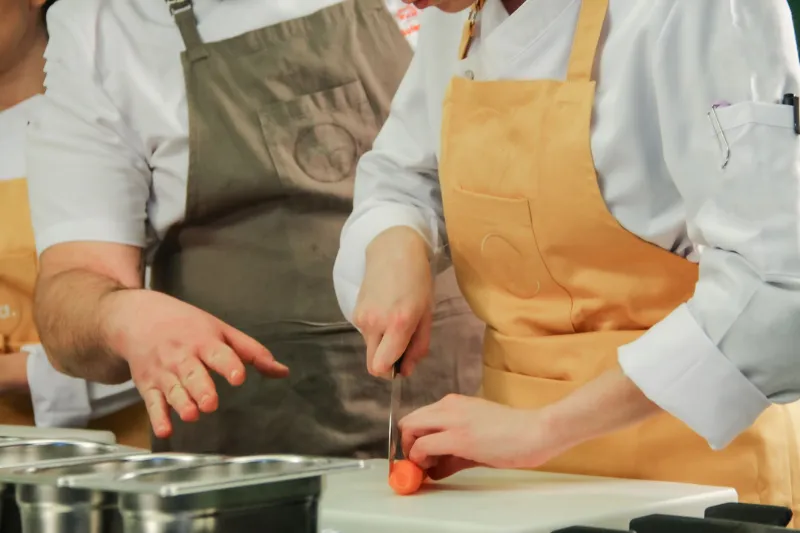
Knife work. Not just sharpening (though that matters enormously), but the actual cutting motions — the push cut, the pull cut, the proper grip that lets the knife do the work instead of your wrist. This is the foundation everything else sits on.
Dashi. Learn to make a proper kombu and katsuobushi dashi from scratch. Do it five times. Ten times. Until the process is completely automatic and the flavor is something you can identify by smell before you even taste it. Once you know what real dashi tastes like, you'll understand why it's the backbone of so much Japanese cooking — and you'll start seeing how to use that knowledge in non-Japanese dishes too.
Seasoning sequence. Japanese cooking has a traditional order for adding seasonings — sake, mirin, sugar, soy sauce, miso — and that order isn't arbitrary. Each ingredient behaves differently under heat and time, and adding them in the right sequence produces a different result than adding them all at once. Learn the sequence, understand why it exists, then decide consciously when and whether to deviate.
Rice. Perfect rice is a kata unto itself. The washing, the soaking, the water ratio, the heat management, the resting time. It seems simple. It takes longer than you'd expect to truly master. And once you have it, you'll have a baseline that makes every rice-adjacent dish easier to understand.
Freedom Through Form
There's a paradox at the heart of kata that takes a while to fully appreciate: the more completely you internalize a rule, the more freely you can choose to break it. A cook who has never learned the traditional way to balance a ponzu sauce doesn't have the creative freedom to reimagine it — they just have uncertainty. A cook who has made it correctly dozens of times knows exactly what they're departing from when they experiment, and that knowledge is what makes the experiment meaningful.
This is what Okubo's kitchen is really about when it comes to craft. Not rigidity. Not tradition for tradition's sake. But the recognition that genuine creativity — the kind that produces something new and actually good — comes from a place of deep understanding rather than comfortable ignorance.
Learn the rules. Learn them until they feel like breathing. Then, and only then, start breaking them on purpose. That's when cooking gets really interesting.