Why the Way Your Kitchen Is Set Up Might Be Holding Your Cooking Back
Most of us treat kitchen organization as a practical problem — where does the colander go, how do we fit the stand mixer, what drawer gets the spatulas? But at KB Kitchen Okubo, we think about kitchen design differently. The physical space you cook in doesn't just affect how convenient cooking is. It affects how well you cook, how focused you stay, and whether the whole experience feels like a chore or a genuine pleasure.
Japanese culinary spaces — from professional restaurant kitchens to home setups in Tokyo apartments — are designed around a concept that has no clean English translation but loosely means the right thing in the right place at the right time. Everything earns its position. Nothing is there by accident. And the result is an environment that almost coaches you into better technique without you even noticing it.
You don't need to renovate your kitchen to get there. You just need to look at it differently.
The Cluttered Counter Is Costing You More Than You Think
American kitchen counters tend to accumulate. The coffee maker, the toaster, the knife block, the fruit bowl, the mail that somehow migrated from the entryway, the vitamins, the spare keys — it all lands on the counter and stays there. We stop seeing it because it's always been there.
But here's what that clutter is actually doing: it's narrowing your working space, yes, but it's also narrowing your mental space. Research on cognitive load consistently shows that visual clutter competes for attention, even when you're not consciously looking at it. In a kitchen context, that translates to distraction at exactly the moments when you need to be most present — when you're watching a reduction, timing a flip, or tasting for seasoning.
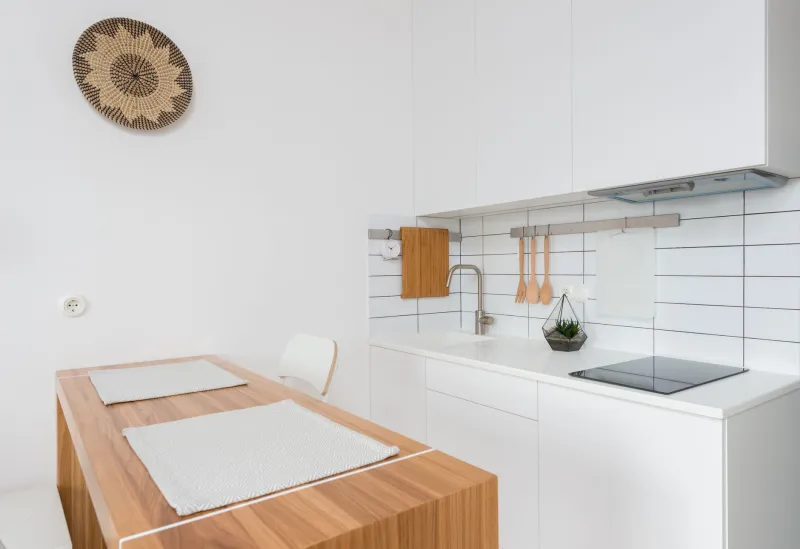
In a traditional Japanese kitchen, the counter is treated as active workspace, not storage. Things that don't belong to the current cooking task are simply not there. This isn't minimalism for aesthetic reasons — it's minimalism in service of focus.
A practical starting point: clear everything off your counter for one week. Put it all somewhere else temporarily. Then only return the items you actually reach for during cooking. You may find that half of what was there wasn't earning its spot.
Natural Light and What It Actually Does for Your Cooking
Light in the kitchen isn't just about being able to see what you're doing. The quality of light affects how accurately you read the color of your food, which — as any Japanese cook will tell you — is critical information.
Harsh overhead fluorescent lighting (still common in American kitchens) flattens color and makes it genuinely harder to distinguish between the deep amber of a properly caramelized miso glaze and the pale gold of one that needs more time. It also creates a kind of clinical atmosphere that runs counter to the mindful, engaged approach to cooking that Okubo is all about.
Natural light is ideal, and if your kitchen has a window, it's worth thinking about how to maximize it. Keep the windowsill clear. Don't block it with a large appliance. Consider what time of day you cook most often and whether the light at that time is working for you or against you.
If natural light is limited — a common reality in urban apartments across the US — warm LED lighting placed at counter level (rather than just overhead) makes a significant difference. It illuminates your work surface from the side rather than from above, which shows texture and color more accurately and makes the whole environment feel less like a lab and more like a place you want to spend time.
The Organization Logic That Japanese Kitchens Run On
In professional Japanese kitchens, mise en place isn't just about having your ingredients prepped — it's about having them arranged in a specific spatial logic that mirrors the sequence of cooking. Things that get used first are closest. Things that get used last are further away. The layout of the station tells a story about the dish before the cooking even begins.
You can bring this thinking into your home kitchen without any major changes. Before you start cooking, take thirty seconds to arrange your prepped ingredients in the order you'll use them, left to right or front to back. It sounds almost too simple to matter, but it eliminates the frantic reaching and searching that interrupts your flow and pulls your attention away from the pan.
For storage, the Japanese principle of ichigo ichie — treating each moment as unique and complete — translates in the kitchen to storing things where they make sense for how you actually cook, not where they fit most conveniently. Your most-used tools should require zero searching. If you're opening three drawers to find your fish spatula every time you cook, that tool needs a new home.
Silence as an Ingredient
This one surprises people. Most American home cooks have the TV on, a podcast playing, or music going while they cook. There's nothing wrong with that — cooking should be enjoyable, and background sound is part of how a lot of us enjoy it.
But there's a specific kind of listening that great cooking requires, and it's hard to do when something else is competing for your ears. The sound of a pan, the bubble of a broth, the crackle of batter in oil — these are all information. They tell you what's happening inside the pot before you can see it.
At Okubo, cooks often work in near-silence not because it's a rule, but because quiet is a tool. It lets you hear what the food is doing.
Try cooking one meal a week in silence. Not as a meditation exercise — just as an experiment. Pay attention to what you hear that you normally don't. You might be surprised how much the kitchen is already telling you.
Small Changes, Real Results
None of what's described here requires a kitchen remodel or a significant budget. Clear your counters. Rethink your lighting. Arrange your prep in sequence before you start. Cook in silence occasionally. These are small shifts in habit and attention, not infrastructure.
But they add up to something meaningful: a kitchen that feels less like an obstacle course and more like a place where good cooking happens naturally. That's the Okubo ideal — not perfection, but intention. Creating the conditions where your best cooking can show up.
The ingredients matter. The technique matters. But the space where it all happens matters more than most people realize.