Why the Way Your Food Looks Is Half the Meal: Japanese Plating Secrets You Can Use at Home Tonight
Here's something worth sitting with for a second: before you've taken a single bite of a meal, you've already formed an opinion about it. Your brain has clocked the colors, the arrangement, the space between components, the vessel it's sitting in — and it's made a judgment. That judgment shapes how the food tastes. This isn't pop psychology. It's a well-documented phenomenon, and it's something Japanese culinary culture has understood intuitively for centuries.
In Okubo's kitchens, the way a dish looks isn't an afterthought. It's part of the dish itself. And the good news for American home cooks is that the principles behind that visual intentionality don't require culinary school, expensive equipment, or hours of extra prep. They require a shift in how you think about the plate before the food goes on it.
The Philosophy Behind the Empty Space
The most immediately noticeable difference between a Japanese plated dish and a typical American dinner plate is what's not there. Japanese plating frequently leaves a significant portion of the plate or bowl completely bare — and that emptiness isn't a mistake. It's a design choice rooted in the aesthetic concept of ma (間), which translates roughly as "negative space" or "meaningful pause."
In Japanese art, architecture, and food, ma is the idea that empty space is itself expressive. It gives the eye somewhere to rest. It creates a kind of visual breathing room that actually makes the food that is on the plate feel more intentional, more precious, and more worth paying attention to.
Contrast this with the default American approach: a full plate is a generous plate. Piling food high signals abundance, hospitality, and value. That instinct is warm and understandable — but it can work against the dining experience by overwhelming the eye before the fork even lifts.
Try this the next time you plate a meal at home: use a slightly larger plate than you think you need, and resist the urge to fill it. Leave at least a third of the surface bare. Notice how the dish suddenly looks more composed — even if you didn't change anything else about how you cooked it.
Color as a Deliberate Ingredient
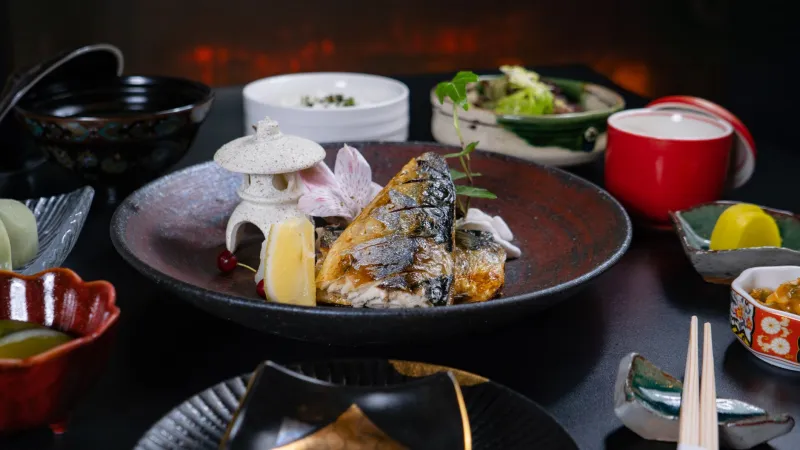
Walk into any Okubo-style establishment and you'll notice that the colors on a plate feel chosen, not accidental. A pale, ivory-toned piece of fish might rest against a dark ceramic bowl, with a single vivid green garnish providing a precise jolt of contrast. Nothing is there by accident.
Japanese plating draws on a concept called goshiki — the five colors — which traditionally includes white, black, red, yellow, and green. A well-composed dish doesn't need to hit all five, but the principle behind it is worth borrowing: before you plate, ask yourself whether there's enough visual variety on the dish to keep the eye engaged.
For home cooks, this is often as simple as adding a fresh herb garnish, a scatter of toasted sesame seeds, or a wedge of lemon. A bowl of miso soup becomes more beautiful with a single thin slice of scallion floating on top. A piece of grilled salmon gets an immediate visual upgrade from a small mound of bright green edamame alongside it. These additions take seconds and cost almost nothing — but they signal care.
Choosing Your Vessels Like You Mean It
One of the most underrated elements of Japanese food presentation is the vessel itself. In Japan, tableware is taken seriously as a craft form. Ceramics are chosen for how they complement the colors and textures of the food, how they feel in the hand, and whether their shape suits what's being served. A rustic, matte-glazed bowl might be perfect for a hearty winter stew. A sleek, smooth white plate might suit a delicate spring dish of chilled tofu.
American kitchens tend to operate on matching sets — the same plates for everything, every night. That's totally practical, and there's nothing wrong with it. But if you want to experiment with more intentional presentation, start paying attention to your bowls and plates the same way you pay attention to your ingredients. Visit a local pottery shop or browse Japanese tableware online — you'd be surprised how affordable handmade ceramics can be, and even one or two interesting pieces can completely change how a meal feels at the table.
And don't overlook the power of size. A small portion served in a small, beautiful bowl feels elegant and intentional. The same portion lost on a massive dinner plate just looks like you didn't make enough food.
Odd Numbers and the Art of Imperfect Arrangement
Here's a quick, practical tip pulled straight from Japanese plating tradition: when arranging multiple elements on a plate, use odd numbers. Three slices rather than four. Five pieces rather than six. Odd groupings feel more natural and dynamic to the human eye — they resist the visual rigidity of perfect symmetry and create a sense of organic arrangement that mirrors how things look in nature.
This pairs well with another Japanese plating instinct: asymmetry. Rather than centering every component, try placing the main element slightly off-center and using smaller components to create balance around it. It takes a little getting used to if you're accustomed to the centered-plate school of plating, but the effect is immediately more interesting.
Making It Work for a Dinner Party
If you're cooking for guests and want to bring some of these ideas to the table without turning your kitchen into a culinary arts studio, here's a simple framework to work with:
Before you plate, decide on one focal point per dish. What's the star? Build everything else around it visually, not just in terms of flavor.
Use garnishes that are also ingredients. A sprig of fresh herb, a few drops of a flavorful oil, a tiny mound of pickled vegetables — garnishes that serve a culinary purpose feel more honest than purely decorative ones.
Slow down the plating process by about sixty seconds. That's genuinely all it takes. Most of the difference between a thoughtfully plated dish and a casually thrown-together one is just a moment of pause to look at the plate before it leaves the kitchen.
Wipe the rim. It sounds small, but a clean plate rim is one of the clearest signals that someone cared. Keep a damp cloth nearby when you're plating and give the edges a quick wipe before the dish hits the table.
The Bigger Picture
What Japanese food presentation ultimately communicates — and what Okubo's culinary philosophy embodies — is respect. Respect for the ingredients, for the craft of cooking, and for the person sitting down to eat. A beautifully presented plate says I thought about this for you. It elevates a meal from fuel to experience.
You don't need to be a professional chef to offer that. You just need to start looking at the plate as part of the dish — not just the surface it gets served on.