The Hidden Language of the Blade: What Okubo's Chefs Know About Cutting That Changes Everything
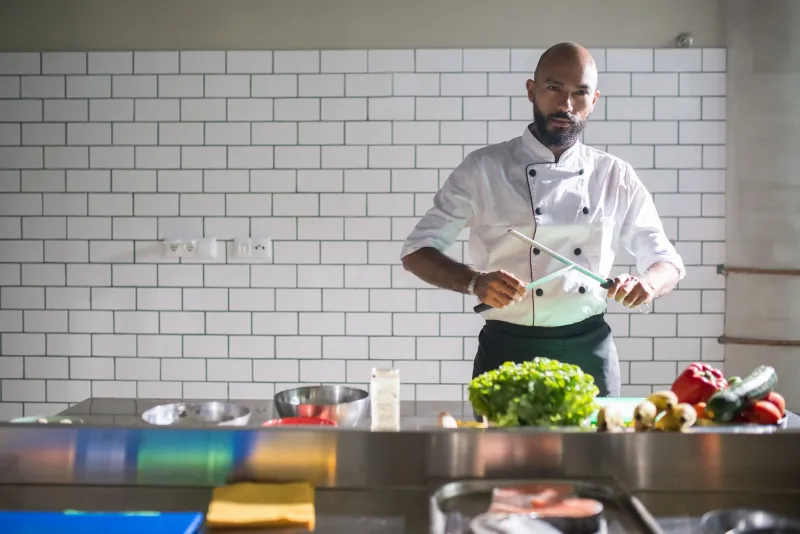
Walk into any serious Japanese kitchen — including our own here at KB Kitchen Okubo — and you'll notice something almost meditative happening at the prep station. A chef stands over a wooden cutting board, moving with unhurried focus. The knife rises and falls in a rhythm that looks deceptively simple. What's actually happening, though, is decades of accumulated knowledge being applied to a single carrot, a fillet of fish, or a block of silken tofu.
That practice has a name: kirimae. And in the world of Japanese cooking, it's about as foundational as breathing.
What Kirimae Actually Means
Western culinary schools teach knife skills as a means to an end — get the onion diced, move on. Japanese culinary philosophy treats cutting as a discipline in itself, one that directly influences how food tastes, feels in the mouth, and even how it absorbs flavors during cooking.
Kirimae literally translates to something close to "cutting technique" or "the manner of cutting," but that translation barely scratches the surface. It encompasses the angle of the blade, the pressure applied, the direction of the cut relative to the grain of the ingredient, and the specific shape each piece is meant to take. A katsuramuki cut — the paper-thin continuous sheet peeled from a daikon radish — requires a knife so sharp and a hand so steady that most culinary students spend months before they can produce a usable strip.
Chef Hiroshi, who oversees our kitchen operations at KB Kitchen Okubo, puts it plainly: "When you cut fish for sashimi with a dull blade or the wrong motion, you're tearing the muscle fibers. The texture changes. The way the fish sits on your tongue changes. A clean draw cut with a properly maintained yanagiba preserves the integrity of every bite."
He's not exaggerating for effect. The science backs him up — compression cuts (pushing straight down) versus draw cuts (pulling the blade through the ingredient) produce measurably different cell structures in the food. That difference shows up as texture on your palate.
Years, Not Weeks
In traditional Japanese apprenticeship culture, a young cook might spend their first year doing nothing but washing rice and watching. Their second year might introduce them to vegetable prep. Knife mastery — real mastery, not just competency — can take the better part of a decade to develop.
That timeline shocks most Americans, who are used to culinary culture that prizes speed and versatility. But the Okubo approach is rooted in something different: the belief that slowing down at the foundational level makes everything faster and better downstream.
"You don't think about the knife after a while," says Keiko, one of our senior prep cooks who trained in Kyoto before making her way to the States. "It becomes like your hand. You feel the resistance of the ingredient and you adjust automatically. But to get there, you have to be very patient with yourself in the beginning."
The knives themselves are part of this story. Japanese kitchen knives — hocho — are typically single-beveled, meaning they're sharpened on one side only. This design allows for extraordinary precision but demands a specific cutting technique. You can't just swap in a German chef's knife and replicate the result. The tool and the method are designed together.
The Knife Shapes You Should Know
Japanese kitchens use specialized blades the way a surgeon uses specialized instruments. Here's a quick breakdown of the ones that show up most often in our kitchen:
- Yanagiba — The long, slender sashimi knife. Designed for single-stroke draw cuts through fish without tearing.
- Deba — A heavier, thicker blade used for breaking down whole fish, including cutting through small bones.
- Usuba — A thin, tall vegetable knife built for the ultra-precise cuts that show up in kaiseki cuisine.
- Santoku — The most approachable for home cooks. Shorter and double-beveled, it handles meat, fish, and vegetables with versatility.
At KB Kitchen Okubo, we use all of these depending on what's being prepared. But if you're cooking at home and want to start somewhere, a quality santoku is your best entry point.
What American Home Cooks Can Actually Do
You don't need to apprentice for five years to start cooking better through improved knife technique. Here are three practical shifts that will make a real difference in your kitchen:
1. Sharpen your knife before every serious cooking session. A dull knife is more dangerous than a sharp one (you press harder and lose control) and it mangles food rather than cutting it. Invest in a whetstone — even a basic 1000/3000 grit combination stone will transform your experience. There are great tutorials online, and the learning curve is gentler than you'd expect.
2. Learn the difference between chopping and slicing. For most vegetables, a rocking chop is fine. But for anything where texture matters — cucumber for a sunomono salad, green onions as a garnish, fish for any raw preparation — practice drawing the knife through the ingredient rather than pressing down. The results are immediately visible.
3. Cut with the grain or against it intentionally. Meat cut against the grain is more tender. Vegetables cut along their natural structure hold their shape better in soups and stir-fries. This sounds basic, but most home cooks never think about it consciously. Start noticing the grain of what you're cutting, and your dishes will improve without changing a single ingredient.
Why This Still Matters in the Age of Food Processors
We get asked this sometimes. Why bother with hand skills when a mandoline or food processor can produce uniform cuts in seconds?
The honest answer is that for some tasks, machines are perfectly fine. But Japanese cooking — particularly the kind we're committed to at KB Kitchen Okubo — is built around the idea that the cook's presence and attention are ingredients too. When a chef hand-cuts katsuobushi shavings or slices tuna for nigiri, they're making micro-adjustments in real time based on what they feel and see. That responsiveness produces results no machine can replicate.
There's also something worth preserving culturally. Kirimae is a living tradition. Every chef who takes it seriously is keeping a centuries-old conversation going — between the cook, the ingredient, and the people who will eventually eat the food.
At KB Kitchen Okubo, that conversation happens every single day. And if you've ever wondered why a dish here feels different from something you made at home with the same ingredients, there's a good chance the answer is somewhere in the motion of the blade.
Come hungry. We'll take care of the rest.